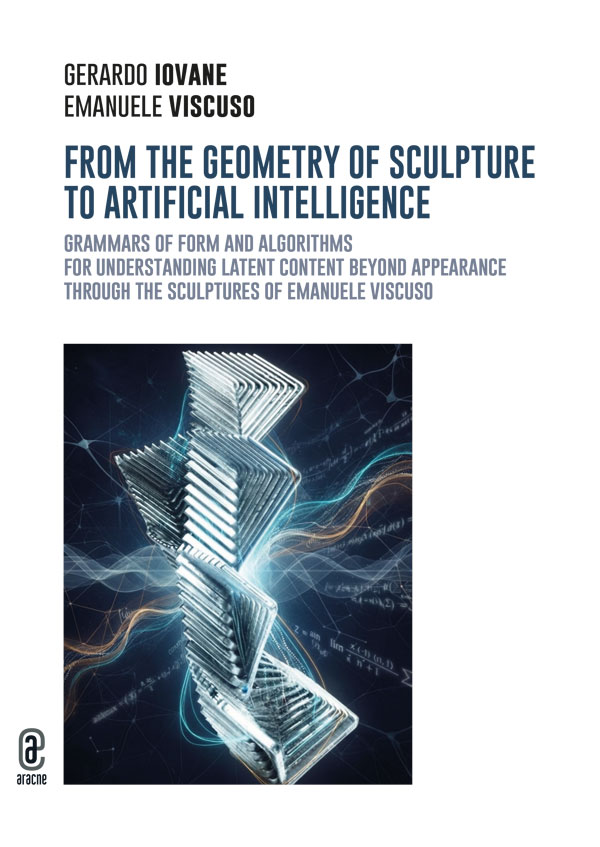
Sculptures are not merely objects. They are the result of a rule governing the arrangement of matter, of a constraint imposed by the material, of a decision that selects among equivalent configurations—and it is precisely in this respect that they resemble, far more than is commonly assumed, the systems that today generate forms computationally. This volume conducts a systematic morphological investigation of Emanuele Viscuso’s sculptural work, reconstructing the generative grammar that has governed his production since 1985, in order to compare it with the logics of contemporary generative models. Organized into twelve chapters, the text proceeds from the analysis of individual works toward geometric formalization: the module arranged in a progressive series, the spiral obtained through accumulation, the fold and the turn in surface geometry, the architectural scale, transformation groups, self-similarity, morphogenesis, and finally the geometry of latent spaces alongside the question of intentionality. The central thesis is one of structural convergence rather than historical causality: two independent practices, operating with incommensurable means, have addressed the same formal problem, arriving at solutions that share specifiable properties. Each chapter of the book specifies which statements are documented, which are argued, and which are merely proposed, indicating the ways in which its thesis can be challenged. Understanding how a form is generated—truly, in its formal detail—is today a skill that pertains as much to art as to science.